Back to School Without the Burnout: 8 Ways to Protect Your Peace
The school year has officially begun for many. The back to school excitement of the first few days has worn off, the emails are coming in, the grading has started, and your calendar is filling up faster than you expected. This is the point when it’s easy to fall into an exhausting cycle:
Teach.
Grade.
Plan.
Email.
Meet.
Repeat.
Before long, you may find yourself bringing work home every night and wondering where your evenings went.
This year, consider doing something different. Become more aware of your mental health and protect your peace before you need to recover it.
Set a Stop Time
One of the simplest ways to create a healthier boundary is to establish a time when your workday ends. Maybe you leave school at 4:30 or work one evening a week but protect the others. There isn’t one right schedule for every teacher.
The important thing is to create a boundary that allows you to have a life outside of school.
You are a teacher. You are also a whole person.
You Don’t Have to Answer Everything Immediately
Emails can create a false sense of urgency. Not every message needs an immediate response. Consider setting specific times during the day to check and respond to email rather than allowing your inbox to interrupt you constantly.
And if your school has expectations for communication, follow those—but remember that responding quickly doesn’t necessarily mean responding thoughtfully. Give yourself permission to pause.
Learn to Say “Not Right Now”
Teachers are often asked to do more. Whether it is another committee, a project, or a favor for someone else. Sometimes the hardest word for a caring person to say is no. But there are other options.
Try:
“I don’t have the capacity to take that on right now.”
Or:
“I’d love to help, but I can’t commit to that this year.”
Or simply:
“Not right now.”
Saying no to one thing can allow you to say yes to the things that matter most.
Stop Grading Everything
You read that right! Not every assignment needs an extensive comment and not every piece of student work needs to be graded. Sometimes students need practice—not a grade.
Look for opportunities to use:
- Self-assessment
- Peer feedback
- Quick checks
- Exit tickets
- Class discussions
- Completion-based practice
- Verbal feedback
Your time is valuable. Use it where it has the greatest impact on student learning.
Build Small Moments of Rest Into Your Day
You may not have an hour for yourself during the school day. But you may have five minutes.
Use them to take a few deep breaths. If you enjoy coffee, drink a cup without checking email. Step outside and go for a walk. Listen to music. Sit quietly. Talk to a colleague about something that has nothing to do with school.
Small moments of recovery matter. You don’t have to wait until Friday, or even Christmas break, to rest.
Find Your People
Teaching can sometimes feel isolating, even when you’re surrounded by people all day. It can make life easier when you have colleagues to go through the ups and downs of life with. Look for others who make you laugh, who you can come to with questions, or those who remind you that you’re not alone when something goes wrong.
You don’t have to navigate every difficult day by yourself. And remember to celebrate the wins together, too. This could look like a student finally understanding something. Or a difficult conversation with a parent that went well. It could even be a student who tells you they enjoyed your class.
Those moments matter. Don’t let the hard days become the only days you remember.
Give Yourself Grace
Sometimes, there will be days when you don’t accomplish everything. You might leave school with papers still on your desk. You go home and you order out because you don’t feel like cooking and you put the laundry off for another day.
There will be days when you simply do your best and call it enough and that is completely fine.
Your worth as a teacher isn’t measured by how late you stay at school, how many bulletin boards you create, how quickly you answer emails, or even by whether you managed to accomplish everything on your to-do list.
A Different Definition of a Successful School Year
So instead of defining success this year about doing more, how about define it by doing what matters most.
That could look like many different things. Maybe it’s about creating meaningful relationships with your students. It could be becoming a little more confident or learning to leave work at work. It could even be about finding joy in teaching again.
Most important of all success looks like ending the school year with wonderful memories and enough of yourself left to enjoy them.
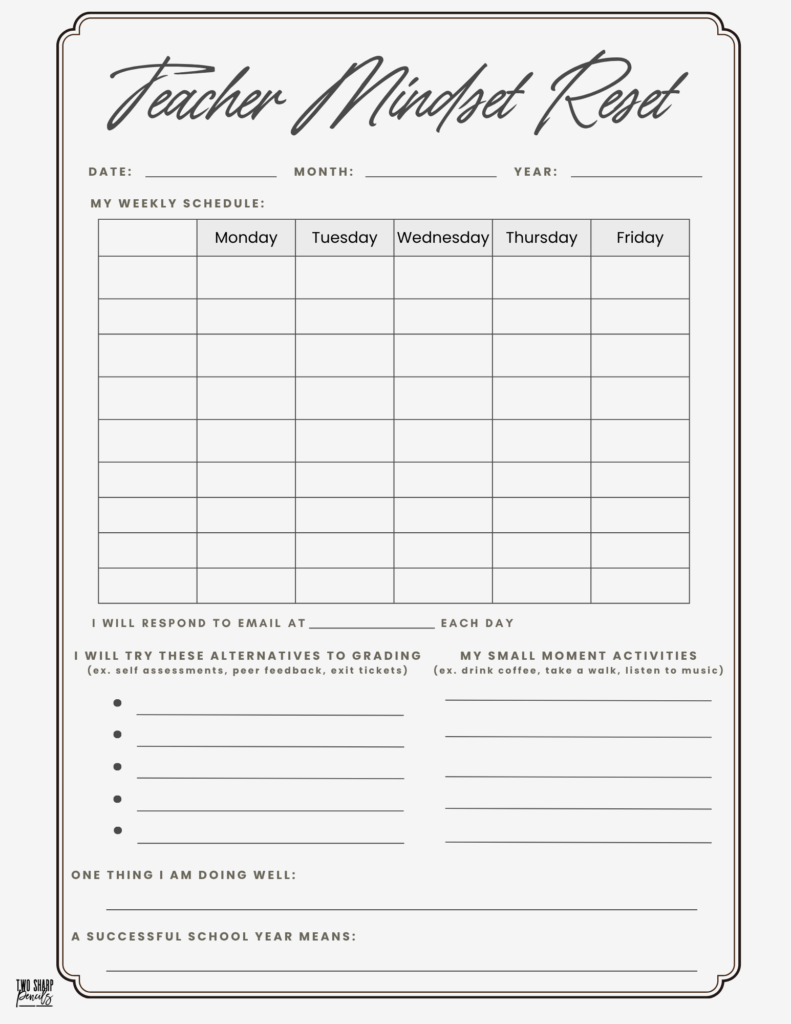
Take some time to figure out how you will protect your peace this year by filling out the Teacher Mindset Reset reflection page. Click the button below to grab it for free!
As you begin this school year, remember:
You don’t have to give everything to your job to be a great teacher.
- Prepare well.
- Teach with purpose.
- Care deeply.
- Set boundaries.
- Take care of yourself.
- And protect your peace.
Because your mental health is important and you deserve to experience the school year—not simply survive it.